
Verbal VOE for Tenant Screening: Speed, Process, and Documentation
Verbal verification of employment (VOE) helps leasing teams confirm real-time employment when applicant documents are unclear or incomplete. This post explains when to use VOE, how it fits into tenant screening workflows, and how to run it in a fast, consistent, and audit-ready way. It’s a practical guide for property managers looking to reduce risk and speed up approvals.

Verbal VOE for Tenant Screening: Speed, Process, and Documentation
A leasing agent has a ready applicant, a unit sitting vacant, and a pay stub that does not match the employer listed on the application. The credit check cleared. The landlord reference came back positive. But the income picture is murky, and the team needs a decision before the applicant moves on to the next listing.
This is exactly where verbal verification of employment (verbal VOE) earns its place in tenant screening. It is a direct phone call to an applicant's employer to confirm active employment, and sometimes job title or income range. When documents leave gaps, a quick employer call can close them.
The challenge is that speed without structure creates risk. A verbal confirmation that never gets documented, or that gets handled differently depending on which leasing agent picks up the file, is not a reliable screening step. Property managers running dozens or hundreds of units need verbal VOE to be fast, yes, but also repeatable and audit-ready.
This piece breaks down when verbal VOE is useful in rental applicant review, how it fits into broader screening workflows, what records to retain, and how to evaluate whether your process (or your provider) is actually working.
What verbal VOE means in tenant screening
Verbal VOE is a live or phone-based confirmation of an applicant's employment, typically initiated by the screening team and directed to the employer's HR department or a verified company contact. The call aims to confirm that the applicant is currently employed, and in some cases, to verify job title, hire date, or income range.
It sits alongside other verification methods like pay stub review, employment letters, bank statement analysis, and automated database checks. Verifying a tenant's current income and employment is considered an essential part of the screening process, with common inputs including pay stubs, employment letters, bank statements, tax documents, invoices, and proof of other income. Verbal VOE is one tool in that broader kit, not a standalone replacement.
The distinction matters because verbal VOE produces a real-time data point. A pay stub from three weeks ago tells you what was true then. A live employer call tells you what is true now.
When leasing teams use verbal VOE
Most leasing teams do not call employers on every application. Verbal VOE typically enters the workflow when something in the applicant's file needs clarification or when speed forces the issue.
Common triggers include a pay stub that lists a different employer than the application, an employment letter with no company letterhead, self-employment claims supported only by bank deposits, or an applicant who recently started a new job and has no pay history yet. In each case, the documents alone are insufficient to make a confident decision.
Urgent approval timelines also drive verbal VOE usage. When a qualified applicant is choosing between competing units, a same-day employer confirmation can be the difference between closing the lease and losing the prospect.
How verbal VOE fits into the tenant screening workflow
Verbal VOE typically occurs after the initial application review and document collection, but before the final approval decision. The standard sequence looks something like this: application intake, credit and background check, document review (pay stubs, letters, bank statements), then employer verification if needed, followed by approval or denial.
Verbal VOE is most useful as a second-layer check. If documents are clean, consistent, and recent, many teams skip the employer call entirely. When documents raise questions, the call fills in what paper cannot.
The key is treating verbal VOE as a defined step with clear triggers, not something that happens on an ad hoc basis depending on who reviews the file.
The verbal VOE process step by step
A reliable verbal VOE process has four phases: contact sourcing, employer outreach, result capture, and escalation.
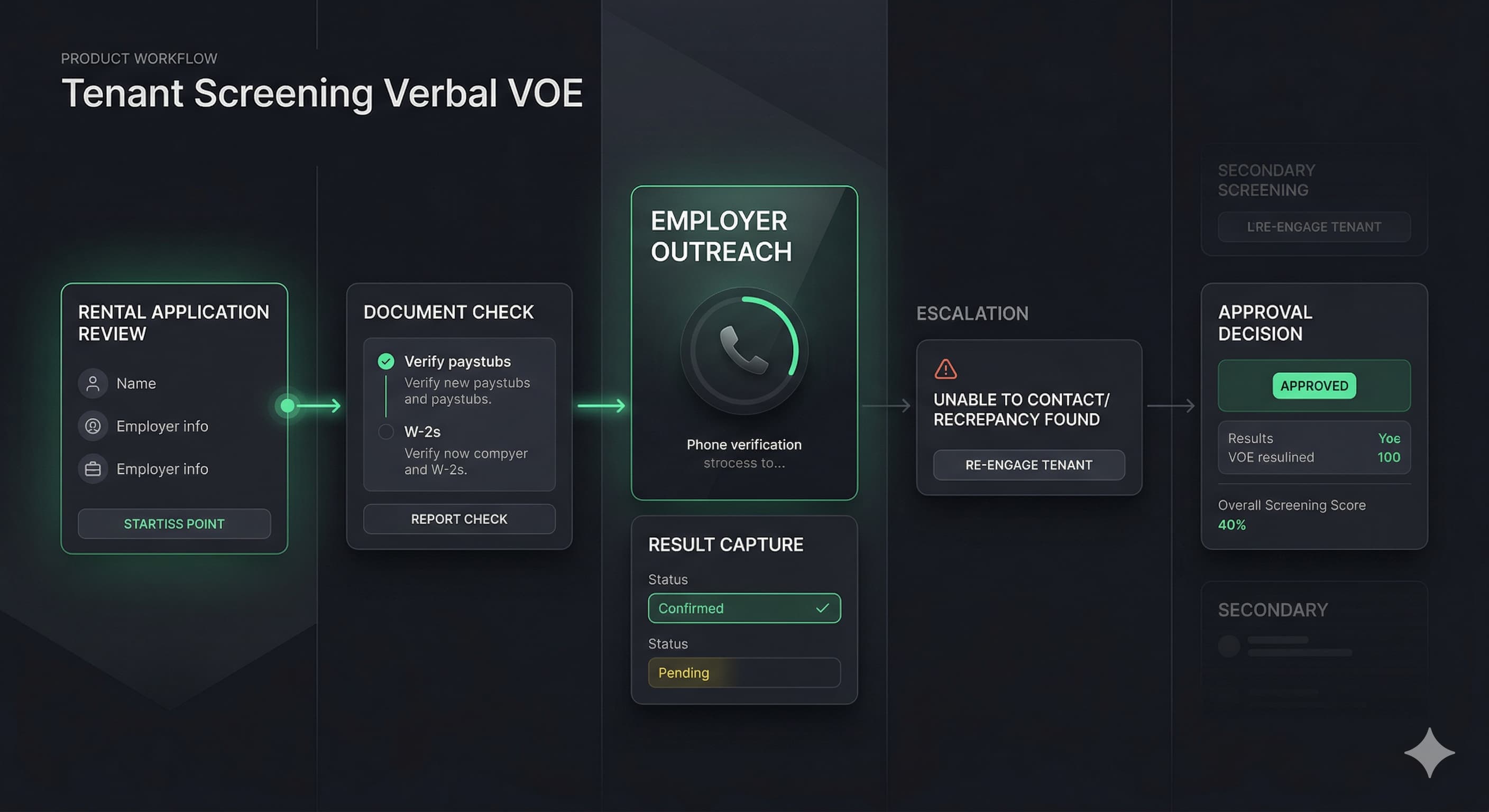
Contact sourcing means identifying a verified phone number for the employer. The applicant-provided number is a starting point, but teams should cross-reference it against the company's public website, directory listing, or a third-party employer database. Calling an unverified number creates a fraud risk, since the applicant could list a personal contact posing as HR.
Employer outreach is the actual call. The person making the call should identify themselves, state the purpose (employment verification for a rental application with applicant consent), and ask specific questions: Is [applicant name] currently employed? What is their job title? What is their start date? Some employers will confirm income; many will not.
Result capture happens during or immediately after the call. The outcome, whether confirmed, denied, or unable to verify, should be logged with timestamps and contact details. A verbal confirmation that lives only in someone's memory is not a verification.
Escalation covers what happens when the employer does not answer, refuses to verify, or the contact information cannot be confirmed. Teams need a defined next step: retry with a different department, request additional documents from the applicant, or flag the file for manager review.
What should be documented in a tenant-screening verbal VOE
Documentation is what separates a useful verification from an anecdote. Every part of the tenant screening process should be documented for future reference, and verbal VOE is no exception.
A file-ready verbal VOE record should include:
- Applicant name and application ID
- Employer name as confirmed during the call
- Employer contact or department (e.g., HR, payroll, direct supervisor)
- Phone number used for the outreach
- Source of contact information (applicant-provided, company website, third-party database)
- Date and time of outreach
- Employment status confirmed (active, terminated, unable to verify)
- Job title and start date if provided
- Unable-to-verify outcome and next step if the call was unsuccessful

Teams that skip any of these fields create gaps that are hard to reconstruct later. If a denied applicant challenges the decision, or if an auditor reviews the file, the verbal VOE record needs to stand on its own.
Why documentation and consistency matter
Consistent documentation protects both the applicant and the property management team. When screening decisions affect who gets housing, the process needs to be standardized across staff, properties, and applicant scenarios.
HUD has issued guidance on rental applicant screening under the Fair Housing Act, and while the specifics of what HUD requires for verbal VOE are not prescribed in detail, the broader principle is clear: screening workflows should be applied consistently and should not create disparate treatment. Standardized verbal VOE procedures, with documented outcomes and repeatable steps, support that principle.
The operational angle matters too. In a portfolio with 20 properties and eight leasing agents, two agents handling the same ambiguous pay stub differently is a process failure, not just a compliance concern. Documentation creates accountability and makes training easier.
Why turnaround time matters in leasing operations
Verification delays slow approvals. In competitive rental markets, applicants often apply to multiple properties simultaneously. A screening process that takes three days when a competitor's takes one creates measurable applicant drop-off risk.
Same-day verbal VOE is most relevant in scenarios where the application is otherwise complete, the employer is reachable during business hours, and the team needs a fast decision to hold a unit. It is an exception-handling tool, not a default for every file.
Speed without documentation, though, is a false economy. A fast verbal confirmation that produces no record does not reduce risk. It just moves faster while creating the same gaps.
Multifamily and centralized leasing considerations
Centralized leasing teams operating across multiple properties face a specific version of the verbal VOE problem. They process high volumes of applications, often with shared staff who rotate between communities. Workflow consistency is not optional in that environment; it is the baseline requirement.
For these teams, verbal VOE needs to be a standardized workflow step with clear triggers, scripted questions, and a consistent documentation format. If one agent at Property A documents employer calls in a CRM note and another agent at Property B uses a spreadsheet, the portfolio has no consistent verification record.
Centralized operations also benefit from batching verification calls during business hours and routing unable-to-verify cases to a single escalation queue. The goal is throughput with quality, not just throughput.
Verbal VOE vs. other verification methods
Different verification methods serve different purposes. Understanding the tradeoffs helps teams decide when verbal VOE adds value and when it is unnecessary.
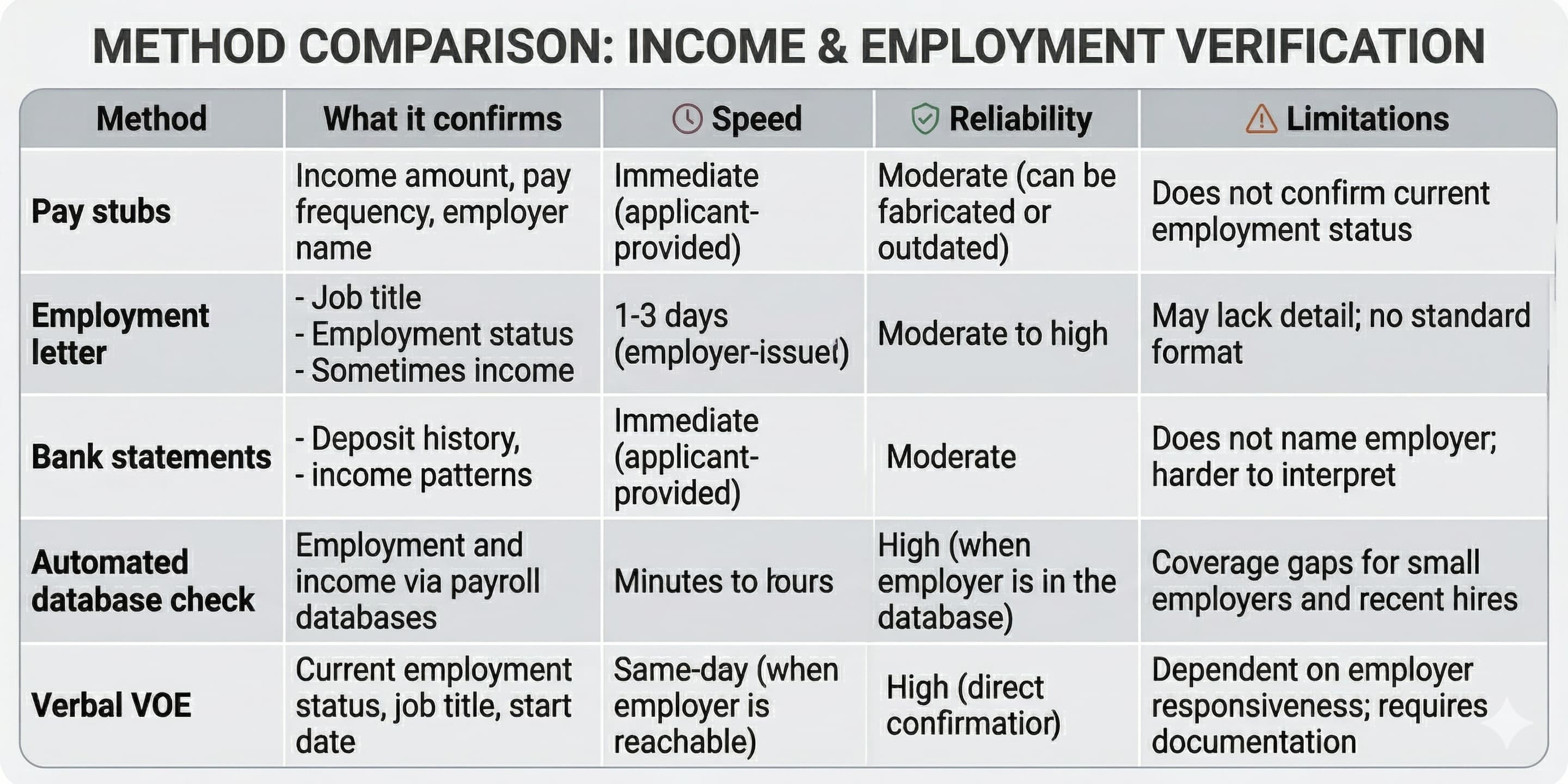
Pay stubs and bank statements are applicant-provided, which means the screening team is relying on the applicant's own documentation. Employment letters come from the employer, but they are static and may be weeks old by the time they reach the file. Automated checks are fast and scalable, but they depend on employer participation in payroll databases, which leaves gaps for smaller companies and recent job changes.
Verbal VOE fills the space where documents are ambiguous and automated systems have no data. It is a real-time, direct-source confirmation, and its primary limitation is employer availability.
Common failure points in tenant employment verification
Several predictable problems undermine verbal VOE when teams do not plan for them.
Unresponsive employers are the most common issue. Small businesses may not have a dedicated HR line. Large employers may route verification calls through third-party services like The Work Number, which may charge fees or require specific authorization. Teams that assume every employer will answer a phone call on the first attempt will frequently hit dead ends.
Bad contact data is the second failure point. If the team only uses the phone number the applicant provided, there is no independent confirmation that the number actually reaches the employer. Cross-referencing against public records, company websites, or employer databases reduces fraud risk.
Inconsistent internal follow-up rounds out the list. When a verbal VOE attempt fails, what happens next? If the answer depends on which agent is working that day, the process is not standardized. A defined escalation path (retry, request alternate documentation, escalate to a supervisor) keeps files moving.
What property teams should look for in a provider
Some property management teams handle verbal VOE internally. Others outsource it to screening vendors or specialized verification providers. Either way, the evaluation criteria are the same.
Turnaround time is the first filter. Can the provider or internal process consistently deliver same-day results for reachable employers? If not, the speed advantage of verbal VOE disappears.
Employer reach matters because verification is only useful if the provider can actually connect with the employer. Ask about their process for sourcing contact information, how they handle third-party verification services, and what their unable-to-verify rate looks like.
Documentation quality is non-negotiable. The output should be a structured record with all the fields listed in the documentation section above, not a freeform note that says "confirmed employment." If the record would not survive a file audit, it is not good enough.
Operational consistency means the process works the same way across properties, staff members, and applicant scenarios. For multifamily operators, this is often the deciding factor between handling VOE internally and using an external provider.
Key objections and decision criteria
Property managers evaluating verbal VOE processes or providers typically raise a few recurring concerns.
"We can just check pay stubs." Pay stubs confirm past income, not current employment. An applicant who was terminated last Friday may still have a current pay stub. Verbal VOE confirms status as of the date of the call.
"Our leasing agents can make the calls themselves." They can, but the question is whether they will do it consistently, document it properly, and follow up on failed attempts. For a single-property operation with low volume, internal calls may work fine. For a portfolio, the inconsistency risk grows with every additional agent and property.
"Is same-day turnaround realistic?" For employers with staffed HR departments and standard business hours, yes. For small businesses, gig employers, or companies that route all verifications through third parties, same-day is harder. A realistic process accounts for both scenarios.
"What about compliance risk?" The compliance argument actually favors verbal VOE when it is documented and standardized. An ad hoc process where some applicants get called and others do not, with no documentation either way, is a bigger risk than a consistent workflow with clear records.
Frequently asked questions
Is verbal VOE required for tenant screening?There is no universal legal requirement to perform verbal VOE on every rental application. It is a best practice that becomes more important when applicant-provided documents are incomplete, inconsistent, or insufficient to support an approval decision.
What if the employer refuses to verify?Log the attempt, note the refusal, and move to an alternate verification path. Some employers have policies against phone verification or require written consent. An unable-to-verify outcome is a legitimate result, as long as it is documented and the team follows a consistent next step.
How do you verify employment for self-employed applicants?Verbal VOE is not typically applicable for self-employed applicants because there is no employer to call. In these cases, teams usually rely on tax returns, 1099 forms, bank statements, and CPA letters. Some teams call listed business references or clients as an alternative.
Can verbal VOE be used as the sole verification method?It can, but it probably should not be. Verbal VOE is strongest as a confirmatory step layered on top of document review. Using it alone means the entire employment verification rests on a single phone call, with no supporting paper trail from the applicant.
Scenario examples
Scenario 1: Mismatched employer name. An applicant lists "ABC Properties" on the application but submits a pay stub from "ABC Management Group LLC." A verbal VOE call to the company's HR line confirms they are the same entity and the applicant is actively employed. The record closes the discrepancy.
Scenario 2: Recent job change. An applicant started a new position two weeks ago and has no pay stubs yet. They provide an offer letter, but it does not confirm they actually started. A verbal VOE call to the employer's HR department confirms active employment and a start date consistent with the letter.
Scenario 3: Employer is unreachable. A small business employer has no HR department and does not answer the listed phone number. After two documented attempts on different days, the team flags the file and requests two months of bank statements showing consistent deposits. The unable-to-verify outcome and alternate path are both logged.
Buyer checklist for verbal VOE in tenant screening
When evaluating your internal process or a potential provider, confirm the following:
- Employer contact information is independently verified, not just applicant-supplied
- The process produces a structured, file-ready record for every attempt
- Unable-to-verify outcomes have a defined escalation path
- The same process applies across all properties and leasing staff
- Same-day turnaround is achievable for reachable employers
- Documentation includes all recommended fields (applicant name, employer name, contact, phone number, source, date/time, outcome)
- The workflow supports both standard employment and exception cases (small employers, third-party verification services, recent hires)
Conclusion
Verbal VOE is not the first step in tenant employment verification, and it is not always necessary. It earns its place when applicant-provided documents are ambiguous, when employment status needs real-time confirmation, or when a leasing team needs to close a file quickly without cutting corners.
The value depends entirely on process quality. A verbal confirmation with no documentation is barely better than a guess. A structured workflow with verified contacts, consistent scripting, timestamped records, and defined escalation paths turns a phone call into a reliable screening step.
For property managers and leasing operations leaders, the question is not whether verbal VOE is useful. It is whether your current process produces results that are fast, documented, and consistent enough to hold up across every applicant, every property, and every file review.
Related Posts
Calling HR Departments for Employment Verifications
Employment Verification API for Fast, Compliant Verifications
Verbal VOE for Mortgage: Process, Compliance, and Turnaround
Ready to get started?
Major CRAs trust us to handle the verifications no one enjoys — faster, cheaper, and fully documented. See how!