
Offer Letter Verification for Landlords: A Complete Guide
Offer letters are increasingly common from new-hire rental applicants — but they're also easy to fake and impossible to cross-reference without pay stubs. This guide covers what a credible offer letter must include, how to spot a fraudulent one, and the exact steps to verify it directly with the employer. Plus: when manual verification breaks down at scale and how AI-powered verbal VOE automates the employer outreach step.
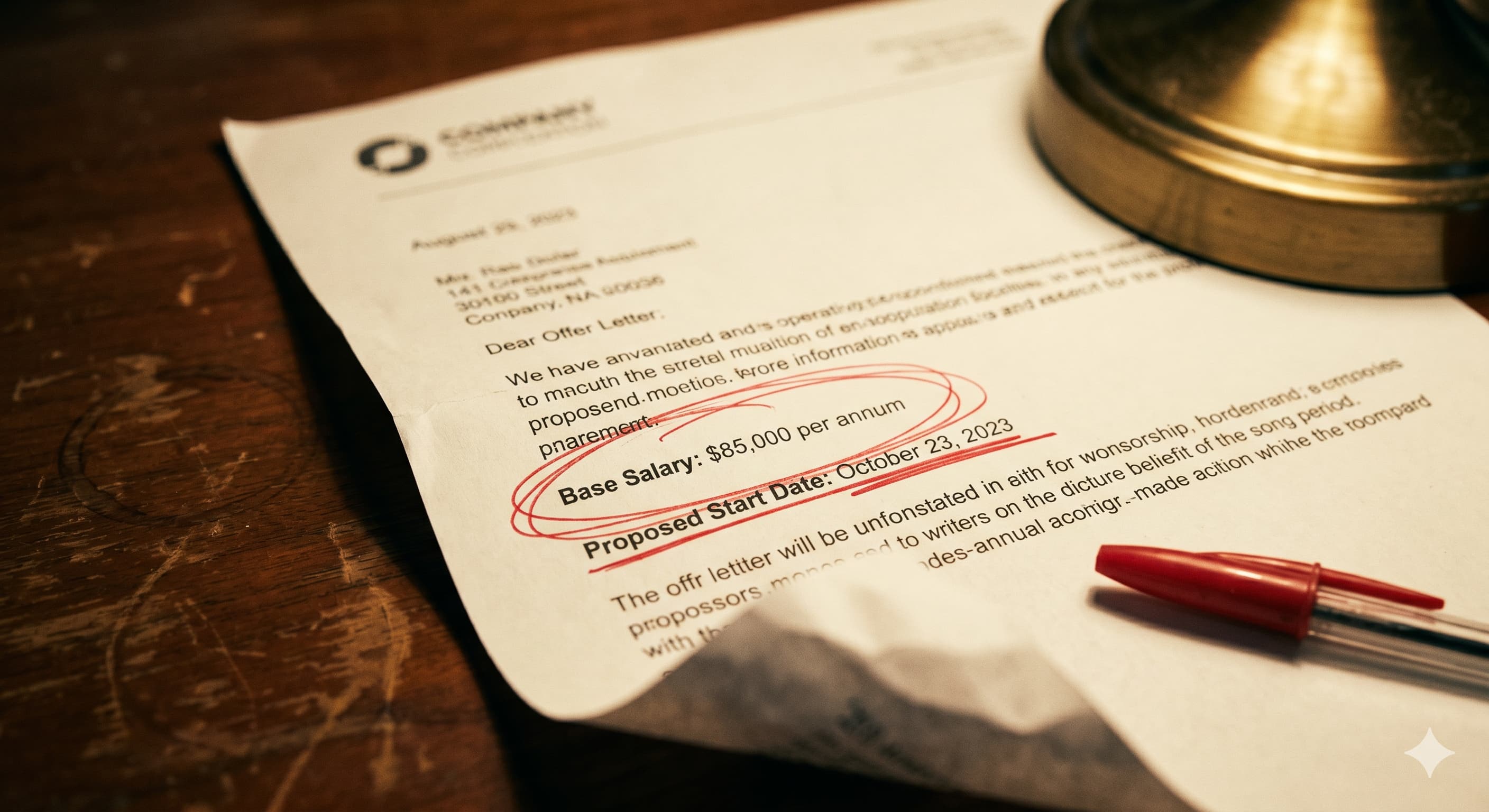
Offer Letter Verification for Landlords: A Complete Guide
A new applicant looks great on paper. Good credit, solid references, and a job offer letter showing a $75,000 salary at a recognizable company. The problem: they haven't started yet, so there are no pay stubs to cross-reference.
One landlord captured the frustration perfectly in a Facebook group: "The applicant did share an employment letter but they only just started work and thus have no pay stubs I can cross reference." That scenario is increasingly common, and the verification gap it creates is a real liability. According to Ocrolus, generative AI tools now enable applicants to produce convincing fake pay stubs, bank statements, and tax documents that bypass traditional screening. Tools like Superunit, which provides AI-powered verbal employment verification for property managers and background screening companies, exist specifically because document review alone no longer catches sophisticated fakes.
Offer letter verification fills that gap, but only when done correctly. The document itself is a starting point, not a finish line.
What an Offer Letter Can (and Cannot) Tell You
An offer letter, when legitimate, confirms a few useful facts: the applicant has been offered a specific role, at a stated compensation, with an expected start date. ApartmentList notes that offer letters are particularly helpful when you don't have pay stubs or bank statements yet.

What an offer letter cannot tell you is whether the applicant actually accepted the offer, whether the offer is still active, or whether the person will show up on day one. Offers get rescinded. Candidates change their minds. Companies restructure before a new hire's first morning.
Greystar, one of the largest property management firms in the U.S., puts it simply: offer letters can verify income, especially for new hires, by outlining salary, start date, and employment details, but an offer letter alone may not be sufficient. The document tells you what was promised. Verification tells you whether the promise still holds.
What a Credible Offer Letter Must Include
Not all offer letters carry the same weight. A one-paragraph email saying "We'd love to have you on board" does not meet the bar for income verification. A credible offer letter should include all of the following:
- Official company letterhead with logo and physical address
- Applicant's full legal name
- Job title
- Compensation details (salary or hourly rate, full-time or part-time status)
- Confirmed start date (not "tentative" or "to be determined")
- Name and signature of the HR representative or hiring manager
- Direct contact information for the person who issued the letter
Apartments.com confirms that you can use an official job offer letter as proof of income as long as it includes salary information, though the letter might have to be paired with another document at the landlord's discretion. If any of the items above are missing, treat the letter as incomplete and request a revised version or supplementary documentation.
Red Flags That Signal a Fake or Altered Offer Letter
Resistant AI reported in June 2024 that fraudsters routinely use fake documents to bypass tenant screening. Offer letters are particularly easy to fabricate because there is no standardized format. Any document on letterhead can appear legitimate at first glance.
SingleKey recommends looking for inconsistencies in formatting, blurry text, and mismatched fonts. Beyond visual inspection, watch for these contextual red flags:
- Salary figures that seem unusually high for the stated role or industry
- A vague or missing start date
- No HR contact name or direct phone number anywhere on the letter
- An email domain that doesn't match the company's website
- A company that can't be found through a basic online search
A letter that checks every visual box can still be fraudulent. The only reliable way to confirm an offer letter's legitimacy is to contact the employer directly, using a phone number you sourced independently.
Offer Letter vs. Pay Stub: Why New Hires Are a Special Case
Pay stubs are the standard proof of income for rental applicants because they confirm both employment and actual earnings over time. A new hire, by definition, has neither. They may not receive their first paycheck for two to four weeks after their start date, and some won't have a stub for six weeks or more depending on the pay cycle.
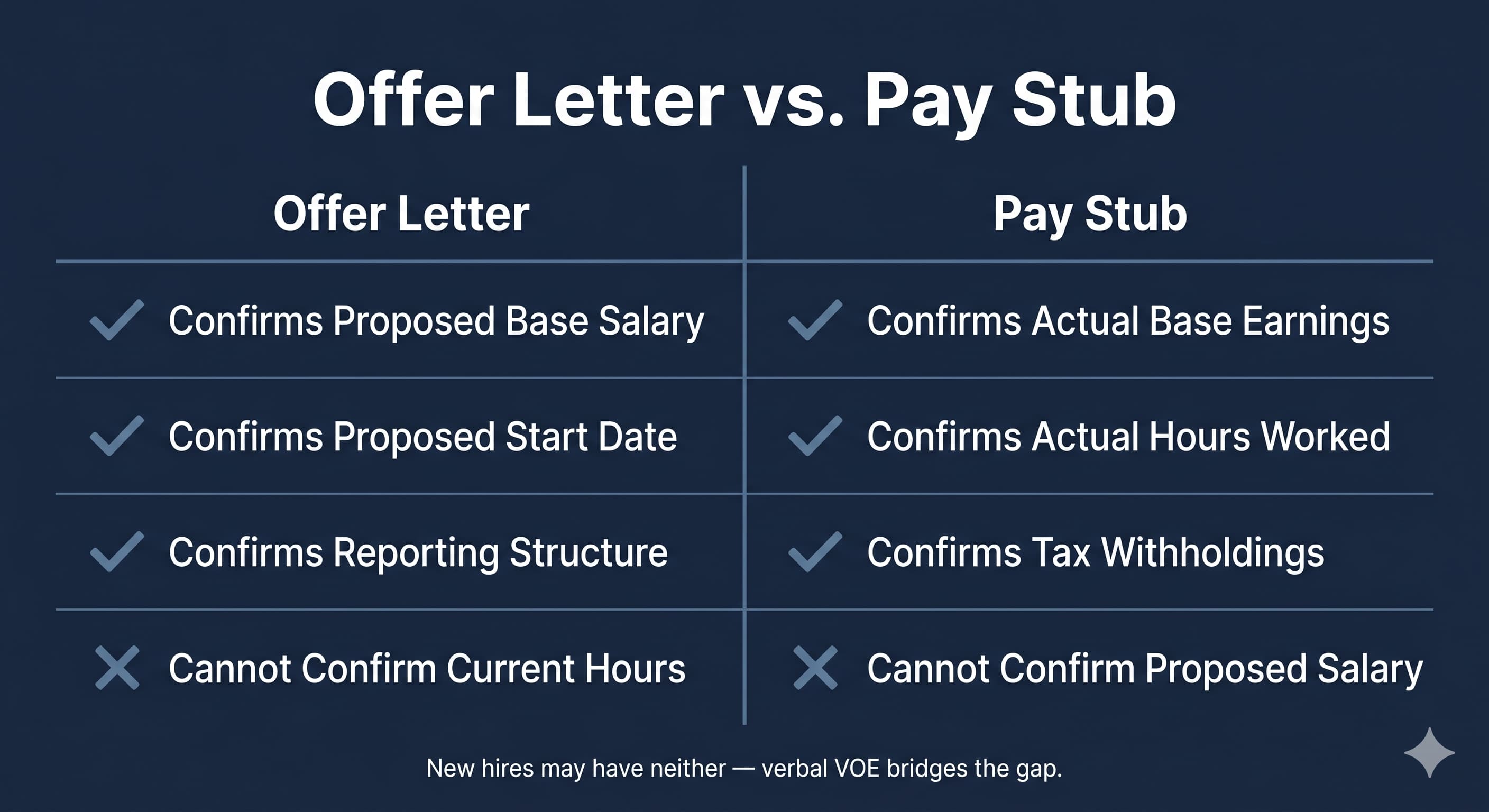
Rejecting every applicant without pay stubs means turning away employed, qualified renters who simply haven't been paid yet. Accepting offer letters without verification means absorbing document fraud risk. The practical middle ground is to accept the offer letter as a valid income document and then verify it through employer outreach.
That verification step, often called verbal verification of employment (verbal VOE), is what separates a reasonable landlord from a vulnerable one. Experian defines verbal verification of employment as "a process of confirming the accuracy of information by requesting confirmation from a source through a spoken conversation."
How to Verify an Offer Letter with the Employer
RealPage recommends that employment verification letters should be independently verified, with the best practice being to call the employer directly. If you're handling verification yourself, follow these five steps.
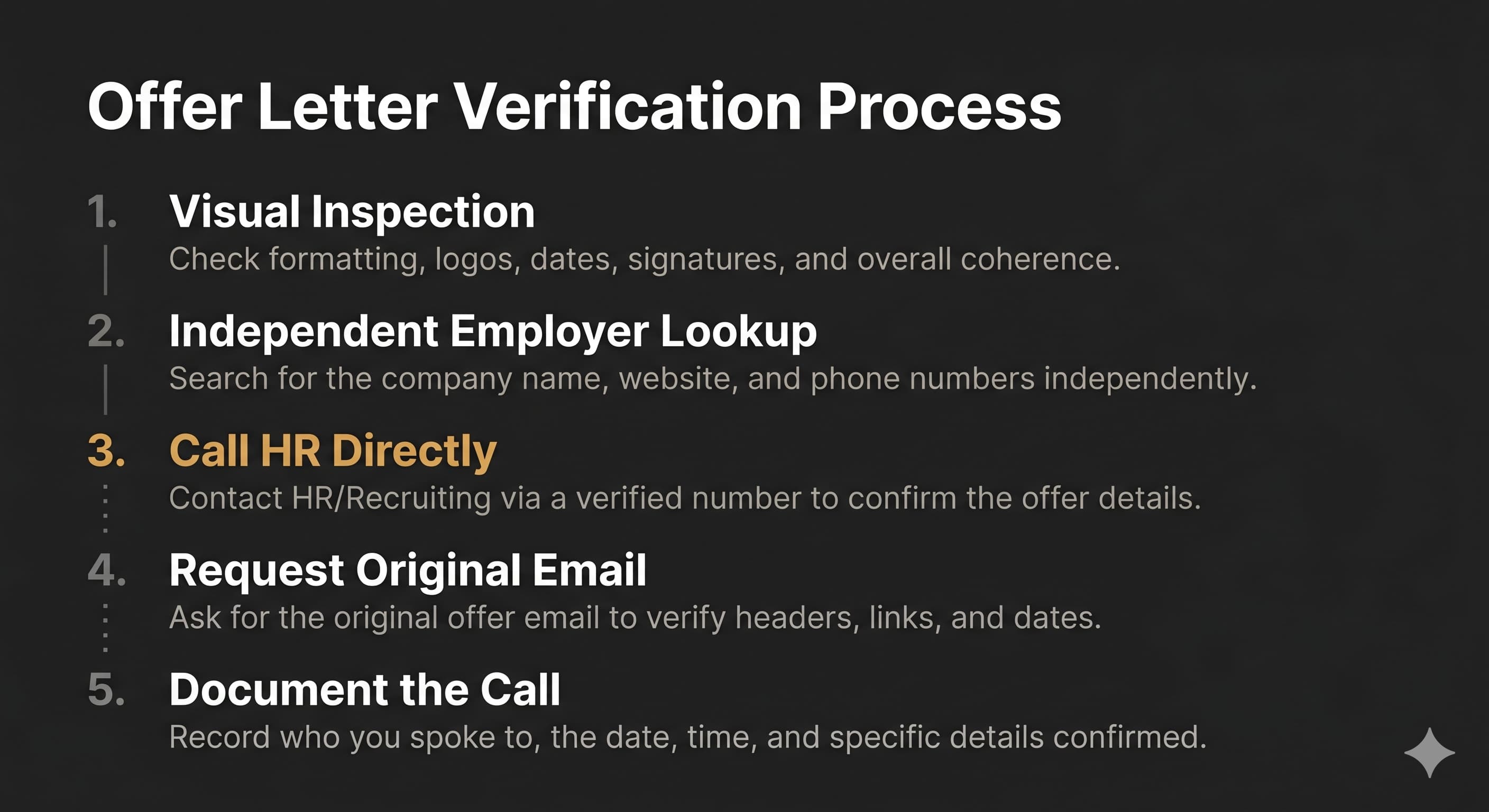
Step 1: Visual inspection. Check the letter for formatting consistency, proper letterhead, and font uniformity. Flag anything that looks off before you spend time on a phone call.
Step 2: Independent employer lookup. Find the company's main phone number through their official website, Google Business listing, or LinkedIn company page. Do not use the phone number printed on the offer letter itself, because a fabricated letter will include a fabricated number.
Step 3: Call HR directly. Contact the company's HR department or the hiring manager to confirm the details on the letter. LeaseRunner notes that many apartments do call your employer as part of the employment verification process, typically reaching out to HR or the supervisor listed on the application. Property managers who screen at volume often automate this step through services like Superunit rather than making each call manually.
Step 4: Request the original email. Ask the applicant to forward the original offer letter email (not a PDF or screenshot) so you can see the sender's email domain. A legitimate offer from Acme Corp should come from @acmecorp.com, not @gmail.com.
Step 5: LinkedIn cross-reference. Verify that the company exists on LinkedIn and that the hiring manager or HR contact listed on the letter is a real employee at that organization.
What to Ask When You Call
Keep the call focused. You need five pieces of information:
- Is [applicant name] scheduled to start on [date]?
- What is their job title?
- Is the position full-time or part-time?
- What is the base salary or hourly rate?
- Is the offer still active and not rescinded?
RentPrep describes landlord employment verification as "a simple phone call to verify employment of the tenant." The call itself is straightforward. Getting someone at the company to pick up and answer is often the hard part.
How to Document the Verification
Every verification call should produce a written record. Include the date and time of the call, the name and title of the person you spoke with, what was confirmed, and any discrepancies between the letter and the verbal confirmation. Keep the original offer letter on file alongside the call log.
Thorough documentation protects you in two scenarios: if the tenancy goes wrong and you need to demonstrate due diligence, and if a rejected applicant challenges your screening decision. Consistent records for every applicant are your best defense.
When Manual Verification Breaks Down
The five-step process works well for a landlord managing a handful of units. It does not scale. A leasing agent at a 300-unit community processing 40 applications per month cannot realistically make individual employer calls for every new-hire applicant, document each conversation, and follow up on unanswered calls.
HR departments are notoriously difficult to reach by phone. Hold times stretch past 30 minutes. Some companies route all employment verifications through third-party services like The Work Number, which charge per inquiry. Others simply don't return calls from unknown numbers.
The Fannie Mae verbal VOE standard for mortgage lending requires the lender to independently obtain a phone number and contact the employer within 10 business days. Tenant screening has no equivalent regulatory timeline, but the operational burden is the same. Every hour a leasing agent spends on hold is an hour not spent on tours, lease signings, or resident requests.
How AI-Powered Verbal VOE Automates Employer Outreach
Superunit addresses the manual verification bottleneck by deploying AI agents that handle employer outreach. The process mirrors what a diligent leasing agent would do, but without the time cost.
Superunit's AI calls the employer's HR department using an independently sourced phone number, not the one provided on the offer letter. The AI agent confirms the applicant's start date, job title, salary, and employment status during the call. Once the conversation is complete, Superunit returns audit-ready documentation that includes everything a landlord would need for the applicant's file: who was contacted, when, and exactly what was confirmed.
A few things Superunit does not do. It does not verify the applicant's identity; that remains a separate step in your screening workflow (photo ID matching, for example). And it does not make the approval decision for you. The verified data feeds your judgment, but whether to approve, conditionally approve, or decline is still a human call based on your full screening criteria.
For property managers screening dozens of applicants per month, the operational math shifts. Leasing staff no longer need to spend 20 to 45 minutes per verification call, track callbacks, or transcribe their notes into a consistent format. Superunit produces a standardized verification record every time, which also supports FCRA compliance by ensuring each applicant is evaluated through the same process.
Where this matters most: new-hire applicants with no pay stubs. Superunit can complete the verbal VOE before the applicant's start date, giving the landlord a verified confirmation that the job, the salary, and the start date are real.
What to Do If the Employer Doesn't Respond
Sometimes the employer simply won't pick up. Small companies may not have a dedicated HR department. Some organizations have strict policies against confirming employment details by phone. When the verification call fails, you still have options.
Request additional documents. Ask the applicant for bank statements showing existing savings, a signed copy of the offer letter paired with a government-issued ID, or prior employment pay stubs that establish an income history. The combination of an unverified offer letter plus corroborating financial documents can reduce your risk.
Ask for a co-signer or guarantor. A qualified co-signer with verifiable income shifts the financial risk away from the unverified offer letter entirely.
Delay the leasing decision. If the applicant's start date is days away, waiting for the first pay stub may be the simplest path. Communicate the timeline clearly so the applicant can plan accordingly.
Decline the application. If the employer is unreachable, no corroborating documents exist, and the applicant cannot provide a co-signer, declining is a reasonable outcome. Document your reasoning and apply the same standard to every applicant in the same situation.
Building a Consistent Offer Letter Policy
A written policy that specifies how your team handles offer letters protects both you and your applicants. The FCRA requires that screening criteria be applied consistently across all applicants. An ad hoc approach, where one leasing agent accepts an offer letter at face value and another requires full verbal VOE, creates legal exposure.
Your policy should state which documents are accepted as proof of income, what verification steps are required for each document type, and what happens when verification is inconclusive. Train every member of your leasing staff on the policy and document the training.
The policy doesn't need to be complicated. A simple framework works: offer letters are accepted as proof of income when they include all required elements (letterhead, salary, start date, HR contact, signature), and every offer letter is subject to verbal verification with the employer before lease approval. That one sentence, applied uniformly, puts you on solid ground.
Frequently Asked Questions
Can a landlord accept an offer letter as proof of income?
Yes. An offer letter is a valid form of income documentation, especially for new hires who haven't received their first paycheck. Most landlords will want to verify the letter's details with the employer before approving the application.
What should an offer letter include to be valid for rental applications?
A credible offer letter should include official company letterhead, the applicant's full name, job title, salary or hourly rate, a confirmed start date, and the name, signature, and contact information of the person who issued it. Missing any of these elements is a reason to request a revised version.
How do landlords verify an offer letter?
The standard method is verbal verification of employment: calling the employer's HR department (using an independently sourced phone number) to confirm the job title, salary, start date, and offer status. Some landlords do this manually, while others use automated verbal VOE services to handle the outreach and documentation.
What are red flags on a fake offer letter?
Watch for mismatched fonts, blurry logos, email domains that don't match the company's website, unusually high salary figures for the stated role, and missing HR contact information. A letter can look polished and still be fabricated, so direct employer verification is the only reliable check.
What if the applicant's employer doesn't respond to verification calls?
Request supplementary documents such as bank statements, prior pay stubs, or a signed copy of the offer letter paired with government-issued ID. You can also ask for a co-signer, delay the decision until the first paycheck arrives, or decline the application if no corroborating evidence is available.
Can I use an offer letter if the applicant hasn't started work yet?
Yes. An offer letter paired with successful employer verification is a reasonable basis for approving a tenant who hasn't yet started. The verbal VOE confirms that the offer is still active and that the salary and start date are accurate, even if the applicant's first day is weeks away.
Ready to get started?
Major CRAs trust us to handle the verifications no one enjoys — faster, cheaper, and fully documented. See how!