
Manual Employment Verification for Background Screening
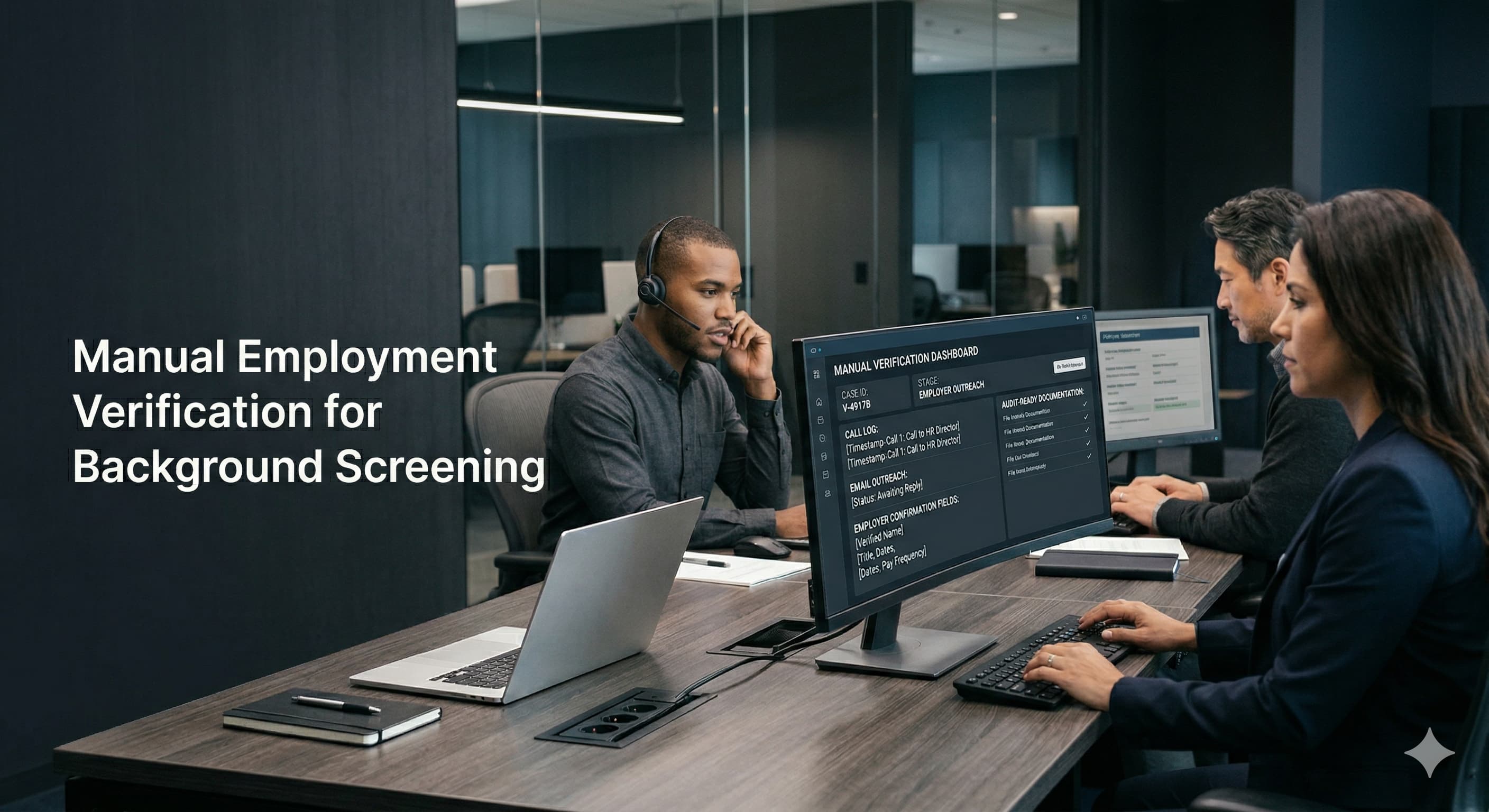
Manual Employment Verification for Background Screening
Automated employment verification works until it doesn't. When a candidate's prior employer is a 12-person landscaping company with no connection to a payroll database, or when an acquired firm's records have gone dark, someone on the screening team has to pick up the phone. Manual employment verification is the process of confirming a candidate's work history through direct outreach to employers who cannot be reached through automated channels, using phone calls, email, or fax.
This guide covers the full manual VOE workflow for background screening companies, recruiters, staffing firms, and in-house hiring teams. The focus is on when employer outreach verification is necessary, what it can realistically confirm, how to handle employers who are difficult to reach, and how to build employment verification documentation that survives client audits and compliance reviews.
What manual employment verification is
Manual employment verification (often called manual VOE in screening operations) is a direct-contact process where a screener reaches out to a current or former employer to confirm specific facts about a candidate's work history. It sits within the broader employment verification for background checks workflow, which may also include criminal history, education verification, reference checks, and other eligibility factors. GoodHire frames employment verification as one component inside a larger screening process, and that framing holds up in practice.
Automated verification pulls data from payroll databases, employer-connected platforms, or third-party verification services like The Work Number. Manual verification picks up where those systems stop producing usable results. The screener collects the candidate's stated employment details, independently confirms employer contact information, and reaches out directly to verify the record.
Manual VOE confirms factual employment data: dates, titles, employment status, and sometimes rehire eligibility. It is not a reference check, a performance evaluation, or a compensation audit. Keeping the scope tight protects both the screener and the candidate, and it keeps employer contacts willing to respond next time.
When manual outreach is needed
The most common trigger is a no-hit result from an automated database. The employer simply is not connected to the verification network the screening company queries, so no data comes back.
Small businesses, franchises, recently closed companies, and employers with decentralized HR operations fall outside automated networks far more often than Fortune 500 employers. A regional restaurant chain with 30 locations may have no central HR function that responds to automated requests, even though it employed thousands of people over the past decade. These are the cases that fill up a manual verification queue.
Background screening employment verification also goes manual when the candidate's stated work history conflicts with other records. If a resume lists "Director of Operations" but a database returns "Operations Coordinator," direct employer contact is the only way to clarify which is accurate. Client SLAs and hiring deadlines add pressure too: when an automated check stalls for days with no response, a phone call or fax to the employer may be the fastest path to resolution.
Choosing a channel: phone, email, or fax
Phone employment verification works best when the employer has an accessible HR department or a small team that handles calls directly. It also tends to produce the fastest turnaround when someone actually picks up.
Email employment verification is practical for employers who require written verification requests or prefer a paper trail. It is also easier to document and timestamp than a phone conversation.
Fax employment verification remains relevant for government agencies, healthcare employers, and organizations that still route verification requests through fax-based workflows. If you screen candidates in healthcare or government-adjacent industries, expect to keep a fax line active.
Step-by-step manual employment verification workflow
1. Confirm authorization and case scope
Before any outreach begins, confirm that the candidate has signed a written disclosure and authorization for the background check. The EEOC's guidance on background checks states that employers should get the applicant's written permission before conducting the check. Review the client's instructions to confirm which employment records need verification and how far back the history should go.
Some clients want every position verified going back ten years. Others only care about the most recent two employers. Clarifying scope before the first call saves hours of unnecessary outreach.

2. Collect the candidate's employment details
Gather employer names, dates of employment, job titles, locations, and supervisor names if available. WorkforceQA outlines a practical sequence: obtain consent, collect employment history, choose verification methods, and use supporting documents when employers are unreachable. Ask the candidate for any supporting documents (offer letters, pay stubs, W-2s) that can serve as secondary evidence if the employer cannot be reached.
Candidates who provide thorough employment details upfront reduce the number of follow-up cycles. A missing employer address or outdated phone number can add days to an already slow process.
3. Validate employer contact information independently
Look up the employer's phone number, address, and email through a public directory, the company's official website, or a state business registration. Clarifacts recommends independently validating the past employer's phone number rather than relying only on applicant-provided contact details.
Applicant-supplied numbers occasionally route to personal contacts posing as HR representatives. A quick cross-reference against public records catches most of these. For teams that handle high volumes of manual VOE, maintaining an internal directory of verified employer contacts (with periodic re-validation) cuts down on redundant lookups.
4. Contact the employer directly
Call, email, or fax the verified employer contact using a standardized set of questions. Confirm the specific fields your client requires: employment dates, job title, employment status, and (where permitted) rehire eligibility.
Keep the conversation factual and narrow. Do not ask about the candidate's performance, personal life, or reasons for leaving unless those fields are explicitly within the screening scope and the client has requested them. Straying outside scope creates liability and can make the employer less cooperative on future calls.
5. Document every attempt and outcome
Record the date and time of each outreach attempt, the channel used, the person or department reached, the specific fields confirmed or not confirmed, and any follow-up required.
Log unsuccessful attempts with the same rigor: voicemails left, emails sent to unresponsive addresses, faxes transmitted with no reply. A file that shows three documented attempts across two channels is far more defensible than one with no outreach log at all. This level of employment verification documentation is what separates audit-ready screening workflows from sloppy ones.
What manual employment verification can confirm
Common fields employers may verify
Most employers will confirm basic employment facts: start date, end date (or current employment status), and job title. Some employers will also confirm whether the individual is eligible for rehire, though this varies by company policy. A smaller subset will confirm the department or location where the candidate worked.
What employers may decline to confirm
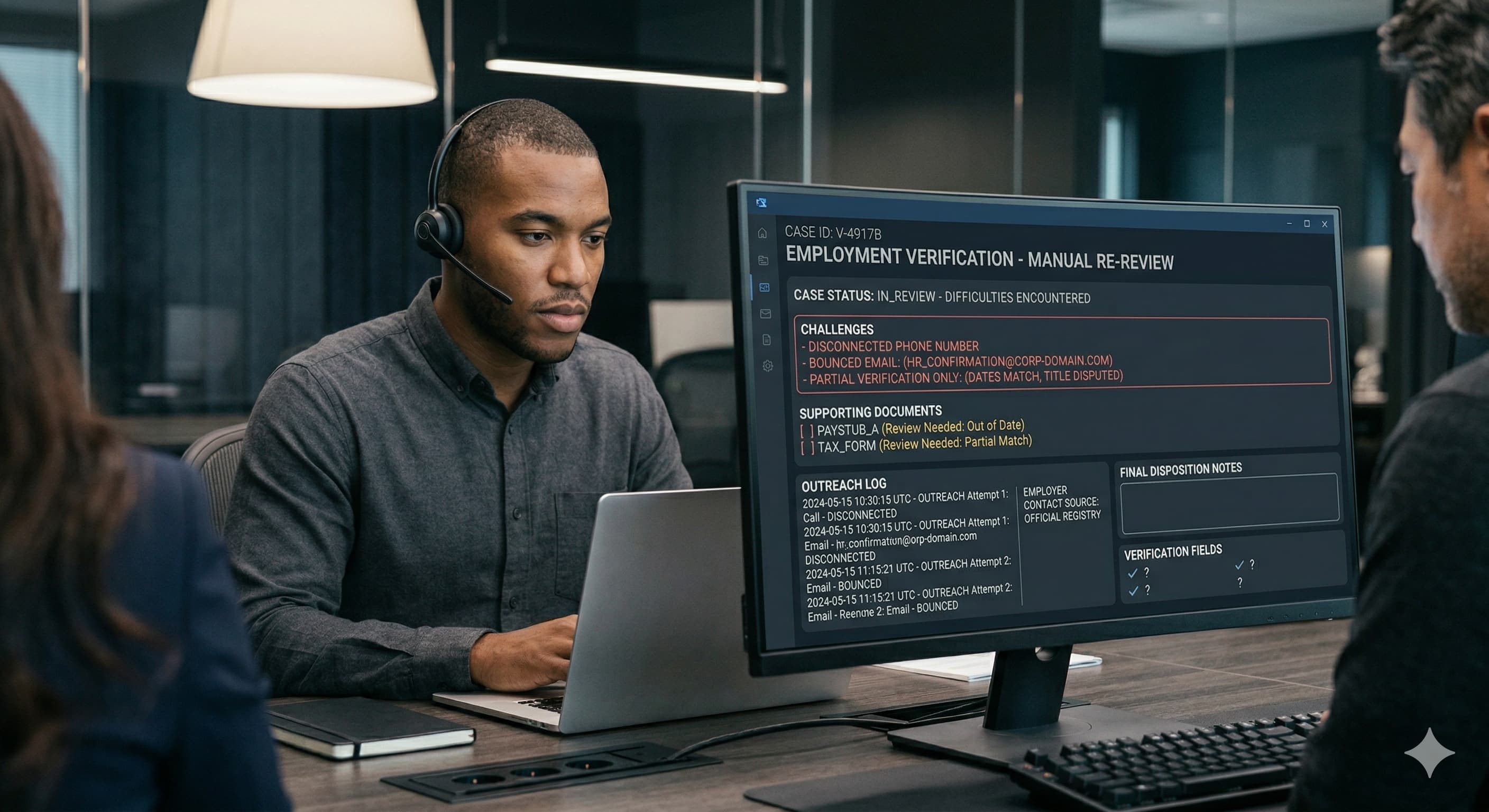
Many employers have internal policies that limit verification responses to dates and titles only. Some companies route all verification requests to a third-party service, which may charge a fee or restrict the fields returned.
A refusal to confirm certain details does not indicate a problem with the candidate's record. It reflects the employer's disclosure policy, and experienced screeners see it on a significant share of cases.
How to handle partial verifications
Partial verification is common, not exceptional. When an employer confirms dates but declines to verify the title, document exactly what was confirmed and what was not. Record the employer's stated reason for limiting the response (company policy, legal department directive, or no reason given).
A partial verification should not be treated as an automatic failure or a red flag. The screening report should clearly separate confirmed fields from unconfirmed fields and note the reason each field remains open. Clients can then make informed decisions based on what was and was not verified. Treating partial results as binary pass/fail outcomes is one of the most common mistakes in background screening employment verification.
Hard-to-verify employers and exception handling
Small businesses are the most frequent source of verification difficulty. A five-person company that closed two years ago may have no active phone number, no HR department, and no forwarding address. In these cases, try to locate a former owner or manager through public records or professional networks.
Acquired companies present a different challenge. If Company A was acquired by Company B, contact Company B's HR team with the original company name and dates of employment. Some acquiring companies retain employment records for prior staff; others purge them during integration. Document which entity you contacted and what they were able to confirm.
Unresponsive HR teams at large employers can stall a case for days. Escalate from a general company line to a specific HR or payroll contact. Try an alternate channel (email instead of phone, or fax if the employer's verification department prefers it). As a last resort, ask the candidate to facilitate an introduction to a direct supervisor who can verify the basics.
When all outreach channels have been exhausted, supporting documents from the candidate (W-2s showing the employer's name and tax ID, offer letters, or pay stubs) can provide corroborating evidence. These documents support the candidate's claim but do not replace direct employer confirmation. The file should note that employer verification was attempted and unresolved, and that supporting documents were collected as secondary evidence. For a deeper look at handling difficult verification scenarios, see our guide to verifying hard-to-reach employers.
Employment verification documentation and audit-ready records
Every manual VOE file should retain the candidate's signed authorization, the source of the employer's contact information (independently validated or applicant-provided), timestamps for each outreach attempt, the channel and contact person for each attempt, and the final disposition.
Separate candidate claims from employer-confirmed facts in the file. A candidate's resume states they held a title; the employer either confirms or does not confirm that title. These are distinct data points and should be recorded separately so the client, QA reviewer, or auditor can see exactly what came from each source.
Preserve evidence of failed outreach. Bounced emails, disconnected phone numbers, fax transmission failures, and employer refusals to verify are all documentable outcomes. A file showing that the screener made multiple good-faith attempts through verified channels is far stronger than one that simply says "unable to verify" with no supporting detail.
.jpg)
Complete logs support both client audits and internal QA reviews. When a client asks why a specific case took five days to close, or why a field was left unverified, the documentation should answer the question without requiring the screener to recall the case from memory. Audit-ready screening workflows are built on this kind of file discipline, not on heroic individual effort.
Consent, compliance, and fair-use considerations
Written disclosure and written authorization are core requirements in third-party employment screening workflows. The FTC's guidance confirms that employment background screening reports are consumer reports under FCRA when a third-party screening company produces them for employment eligibility decisions. Screening teams should confirm that valid authorization is on file before initiating any outreach.
Not every direct employer contact automatically triggers the full set of FCRA requirements. An employer calling another employer directly to verify a candidate's work history operates in a different regulatory context than a consumer reporting agency producing a screening report. The distinction matters, and teams should understand which role they are filling in each workflow. For more on FCRA obligations in screening, see our compliance overview for background screening companies.
The EEOC's background check guidance supports consistent, non-discriminatory treatment in how background information is collected and used. Screening teams should apply the same verification process to every candidate for a given role, avoid verifying fields that are not relevant to the position or screening scope, and avoid making decisions based on protected characteristics. Keep verification questions standardized across candidates and focused on job-relevant facts.
State and local laws may add requirements beyond federal baselines. Because those requirements vary significantly, screening teams should work with qualified legal counsel to confirm compliance in each jurisdiction where they operate rather than relying on general guidance alone.
Employment verification turnaround time expectations
Manual employment verification takes longer than automated checks, and the gap is not small. An automated database query may return results in seconds or hours. A manual VOE case involving phone outreach to an unresponsive employer can take three to five business days, sometimes longer.
Employer responsiveness is the single largest variable in employment verification turnaround time. A large employer with a dedicated verification line may confirm details within one business day. A small business where the owner handles everything personally may take a week to return a call, or may never return it at all.
Retry rules and escalation paths directly affect turnaround. A team that attempts one phone call and then waits indefinitely will see slower completion times than one with a defined schedule: three attempts across five business days using at least two channels, with case closure rules for unresolved records. Setting clear retry limits and escalation triggers keeps the pipeline moving without sacrificing documentation quality. Teams that track turnaround data by employer type and channel can identify bottlenecks and adjust their outreach strategy accordingly.
Best practices for employer outreach verification
Use standardized scripts and question sets. Asking the same questions in the same order for every verification reduces errors and keeps files consistent. Standardization also prevents screeners from inadvertently asking questions outside the permitted scope.
Independently validate employer contact details. Even for employers you have verified before, re-check the phone number or email periodically. HR contacts change, companies move, and phone numbers get reassigned.
Keep outreach factual, narrow, and documented. State who you are, confirm you have the candidate's authorization, and ask only the fields within the screening scope. Do not volunteer information about the candidate's application or share details from other parts of the background check.
Set retry limits and closure rules for unresolved cases. Define how many attempts will be made, across which channels, over what timeframe. When the retry limit is reached without a response, close the case with a clear disposition ("unable to verify, employer unresponsive after three attempts by phone and email over five business days") and move on. A disposition with specifics is always better than a vague "unable to verify."
Know when to shift from automated to manual verification. If your automated verification source has not returned a result within a defined window (24 to 48 hours is typical for many screening operations), trigger the manual workflow immediately rather than waiting for a timeout. Early escalation from automated to manual verification compresses overall turnaround and avoids bottlenecks late in the screening process.
FAQ
What is manual employment verification in background screening?
Manual employment verification is the process of contacting an employer directly by phone, email, or fax to confirm a candidate's work history when automated verification sources return no usable data. Screening teams use it as a fallback when database queries produce no-hit results.
When should a screening team use phone, email, or fax outreach?
Phone employment verification is fastest for employers with accessible HR teams. Email employment verification suits employers who require written requests or when you need a built-in paper trail. Fax employment verification is still standard for government agencies, healthcare organizations, and employers with fax-based verification departments.
What can an employer legally confirm during employment verification?
Most employers will confirm dates of employment, job title, and employment status. Some will confirm rehire eligibility. Many employers limit disclosures by internal policy, and a limited response reflects company practice, not a problem with the candidate.
What should be documented after each outreach attempt?
Record the date, time, channel used, person or department contacted, fields confirmed, fields not confirmed, and any stated reason for a limited response. Log unsuccessful attempts (voicemails, bounced emails, no-answer calls) with the same level of detail. Consistent employment verification documentation is what makes a file audit-ready.
How should hard-to-verify employers be handled?
Try multiple channels (phone, email, fax) and escalate to alternate contacts when the primary contact is unresponsive. For closed or acquired companies, search public records for a successor entity or former owner. When all outreach fails, collect supporting documents from the candidate and close the case as unresolved with a full log of attempts.
Is written consent required for employment verification?
Written disclosure and authorization are required when a third-party screening company produces a consumer report for employment purposes under FCRA. Requirements differ depending on whether the verification is conducted by a consumer reporting agency or by the hiring employer directly.
What happens if an employer will only provide partial information?
Document which fields were confirmed and which were not. Note the employer's stated reason for limiting the response. Report the partial verification to the client with a clear separation between confirmed facts and unverified claims. Partial verification is a normal outcome in manual VOE, not an automatic failure.
Conclusion
Manual employment verification exists because automated sources do not cover every employer, every company structure, or every edge case in a candidate's work history. It is slower, harder to scale, and more dependent on individual screener judgment than any automated workflow. That is exactly why the process around it needs to be tight.
The output that matters most is the file, not the phone call. A manual VOE file that clearly separates candidate claims from employer-confirmed facts, preserves timestamped evidence of every outreach attempt, and records a specific final disposition will hold up under client audits, regulatory review, and internal QA. Build the file as if someone else will need to defend it six months from now, because they probably will.
Related posts
Employment Verification Outsourcing: A Guide for Lean HR Teams
Calling HR Departments for Employment Verifications
Best Employment Verification Platforms for 2026
Ready to get started?
Major CRAs trust us to handle the verifications no one enjoys — faster, cheaper, and fully documented. See how!