
Employment Verification Outsourcing: A Guide for Lean HR Teams
Employment verification outsourcing reduces manual HR workload, speeds routine verifications, and improves control over data release. It works best for lean teams with high request volume, but employers still retain compliance and oversight responsibility.

Employment Verification Outsourcing: A Guide for Lean HR Teams
Employment verification outsourcing is the practice of routing verification requests (employment status, job title, dates, income) through a third-party system or provider instead of handling them internally. The core reason organizations adopt it is practical: HR and payroll teams are shrinking while verification request volumes hold steady or grow.
This is a workflow and controls decision, not a headcount story. Outsourcing reduces the number of manual touches per verification request, improves consistency in how employment data gets released, and centralizes controls that are hard to maintain across a distributed team. None of that removes the employer's legal accountability for how employee information is handled.
If you are evaluating whether to move verification workflows to a third party, you need a clear picture of what changes operationally, what stays the same legally, and where hybrid models fit. The sections below cover each of those dimensions for HR operations, payroll, compliance, procurement, and security stakeholders.
Why Employment Verification Outsourcing Is Getting Urgent
Verification volume does not shrink when your team does. Lending, tenant screening, government benefits, and pre-employment checks all generate inbound requests that land on HR or payroll desks regardless of staffing levels.
When organizations go through hiring freezes, restructures, or shared-services consolidation, the people who used to answer those requests are often the same people absorbing other work. The collision between steady request volume and reduced headcount creates a specific operational pain: requests pile up, turnaround times stretch, and the remaining staff start handling verifications inconsistently because there is no time to follow a careful process. That inconsistency is exactly where compliance and privacy risks surface.

What Employment Verification Outsourcing Actually Includes
The phrase covers more ground than most buyers initially expect. At its narrowest, it means a third party confirms basic employment facts on your behalf. At its broadest, it includes income verification, tax transcript retrieval, identity-linked workflows, and exception management.
Routine Employment Verifications
A credentialed verifier (a lender, a landlord, another employer) requests confirmation of job title, dates of employment, and current status. In a manual model, that request reaches an HR generalist or payroll clerk who looks up the information and responds by phone, email, fax, or form. Outsourced models route these requests through a centralized system or database, cutting internal staff touches per request to near zero for standard cases.
Centralized verification databases, such as the infrastructure described in The Work Number's public documentation, allow credentialed verifiers to access employment records directly. GSA has adopted similar infrastructure for federal payroll shared services, describing it as a way to provide quick answers without routing every request through internal teams. These examples illustrate institutional adoption of the model, not a recommendation of any specific vendor.
Income and Tax-Adjacent Verification Workflows
Many outsourcing arrangements extend beyond basic employment confirmation into income verification. Lenders and government agencies frequently need salary or wage data, and some workflows require IRS tax transcripts retrieved through Form 4506-C under the Income Verification Express Service. If your team is already buried in basic verifications, adding income and tax transcript fulfillment internally is rarely practical.
Exception Handling and Escalations
Not every request fits a standard template. Disputes over reported data, requests involving terminated employees with complex separation circumstances, legal holds, or subpoena-related inquiries require judgment from internal HR, payroll, or legal staff. Any outsourcing model needs a defined escalation path for these cases. A vendor cannot make policy decisions about what your organization should or should not disclose.
How Staffing Reduction Changes the Economics
When teams are fully staffed, the cost of handling verifications manually is often invisible, buried in the daily workload of HR generalists and payroll clerks. When teams shrink, that invisible cost surfaces fast because the same volume of requests now competes with fewer hands.

Administrative Load on HR and Payroll
Verification requests interrupt focused work. Each one involves locating the right record, confirming the requester's identity and authorization, pulling the data, formatting a response, and documenting what was released. Multiply that by dozens or hundreds of requests per month and you have a meaningful drag on teams also responsible for onboarding, benefits administration, payroll processing, and employee relations.
SHRM's verification-of-employment policy resource reinforces that employers need defined policies for who can release employment information and under what circumstances. Without that structure, the administrative burden falls unevenly across whoever happens to pick up the phone or open the email.
Opportunity Cost of Keeping Verifications In-House
The real cost is not the time spent fulfilling requests. It is the time not spent on higher-value work. When your payroll team is answering verification calls, they are not reconciling pay discrepancies, preparing for audits, or supporting open enrollment.
For lean teams, every hour spent on routine verification fulfillment is an hour unavailable for compliance work, employee support, or process improvement. That trade-off sharpens as headcount declines.
Why Hybrid Models Are Common
Full outsourcing is not always the right move. Many organizations land on a hybrid approach: routine employment and income verifications go to a third-party system, while exceptions, disputes, and sensitive cases stay with internal staff. This captures most of the volume reduction without requiring the organization to hand over judgment calls to an external vendor.
Hybrid models also reduce the change-management burden. Internal teams retain ownership of policy and escalation design, which makes the transition less disruptive than a full handoff.
What Changes Operationally with Employment Verification Outsourcing
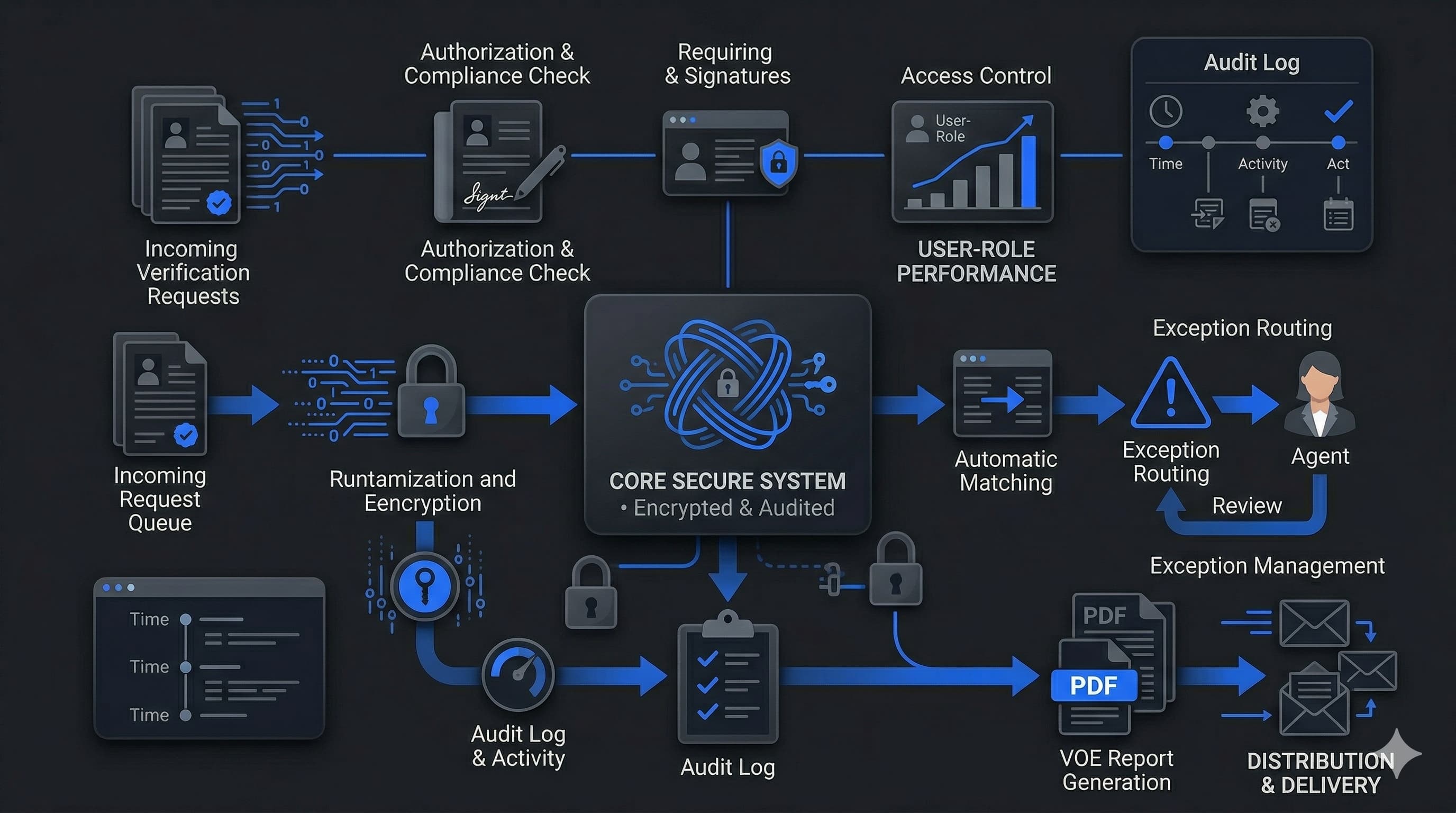
The operational shift moves you from ad hoc fulfillment (inbox triage, callback loops, sticky notes on a desk) to centralized intake, standardized controls, and documented workflows.
Turnaround Time and Workflow Consistency
Manual verification processes are inherently inconsistent. One HR generalist might respond in two hours; another might take five days. Centralized systems reduce callback loops, standardize response formats, and create predictable turnaround times. For verifiers on the other end (lenders, landlords, other employers), faster and more consistent responses reduce friction across the board.
Data Access and Disclosure Controls
Ad hoc handling increases the risk of informal or unauthorized disclosures. A manager might confirm salary information over the phone without checking whether the requester has proper authorization. Outsourced systems can enforce role-based access, capture consent documentation, and limit data release to defined fields. That narrows the surface area for accidental or improper disclosure, which is where policy drift tends to cause problems.
Audit Trails and Reporting
Manual processes rarely produce clean audit trails. You may know that a verification was completed, but not what data was released, to whom, or under what authorization. Documented workflows with timestamped logs create a record that supports internal oversight, dispute resolution, and regulatory review if questions arise later.
What Outsourcing Does Not Change
Outsourcing changes how verification work gets done. It does not change who is accountable for doing it correctly. This distinction is worth stating plainly because it gets lost in vendor sales conversations.
FCRA Obligations Still Apply
If a third-party report is used for an employment decision (hiring, promotion, reassignment, retention), the employer must comply with the Fair Credit Reporting Act. FTC guidance specifies that employers must provide clear disclosure, obtain written authorization, certify compliance to the consumer reporting agency, and follow adverse action procedures when applicable.
CFPB Circular 2024-06 adds a point worth noting: background dossiers and algorithmic scores used in employment decisions can still fall under FCRA, even when packaged in newer formats. Outsourcing to a vendor that uses modern data products does not create a compliance shortcut.
15 U.S.C. §1681b confirms that employment purposes are a permissible purpose for furnishing consumer reports, but only within the statute's boundaries. The permissible-purpose framework applies regardless of whether fulfillment is internal or external.
EEOC and Nondiscrimination Risk Still Apply
EEOC guidance on background checks makes clear that employers must ensure screening practices comply with federal nondiscrimination laws. If a verification or screening input disproportionately excludes protected groups, the employer bears the risk, not the vendor. Moving the process off your desk does not move the liability off your books.
Vendor Oversight Is an Ongoing Obligation
Employers still own the verification policy, the governance framework, and the escalation design. Selecting a vendor is the beginning of an ongoing oversight relationship, not the end of internal responsibility. Service-level agreements, access controls, audit review cadences, and dispute-handling procedures all require active management.
Compliance and Privacy Checkpoints Before Outsourcing
Before signing a vendor agreement, several stakeholders (legal, HR, security, procurement) should work through a practical checklist.
Permissible Purpose and Authorization
Confirm that your verification workflow includes proper disclosure and written authorization before employee data is released for employment-purpose consumer reports. Map which request types require permissible-purpose validation and ensure the vendor's intake process enforces those controls.
Data Minimization and Retention
The privacy benefit of outsourcing depends on how the vendor handles data after fulfillment. Review retention policies, access limits, and audit log practices. If the vendor retains employee data longer than operationally necessary or grants access more broadly than your internal policy would allow, the privacy improvement may be smaller than expected.
Identity Proofing and Fraud Controls
Verification workflows are increasingly targeted by fraud, including synthetic identity schemes and forged documentation. NIST SP 800-63-4 provides updated guidance on identity proofing, fraud resistance, and protections against forged media and injection attacks. Any provider you evaluate should be able to describe how their system addresses these risks with specificity, not vague references to "security."
When Employment Verification Outsourcing Makes Sense
The strongest case for outsourcing shows up under specific, identifiable conditions.
High Request Volume and Lean Teams
If your organization processes a high volume of verification requests monthly and your HR or payroll team has been reduced through attrition, restructuring, or hiring freezes, outsourcing routine verifications is a straightforward capacity decision. The repetitive work is consuming time that your remaining staff need for exception queues, compliance tasks, and employee-facing support.
Multi-State or Complex Compliance Environments
Employers operating across multiple states face a patchwork of privacy, employment, and record-handling rules. Standardized verification workflows can help maintain consistency and reduce the risk of a single location handling requests in a way that conflicts with another jurisdiction's requirements.
Need for Faster, More Consistent Fulfillment
If turnaround time complaints are common, or if you have identified inconsistencies in what data different staff members release, a centralized system can address both problems at once. Consistency in response content and timing is often as valuable as speed alone.
When Outsourcing May Not Fit
Some organizations are better served by improving internal processes or limiting the scope of external involvement.
Low Request Volume
If your organization handles a small number of verification requests per month, the overhead of implementing and managing a vendor relationship may exceed the operational benefit. A well-documented internal policy and a designated point of contact can handle low volumes effectively.
Highly Customized Verification Policies
Some organizations have unusual approval rules, multi-layered sign-off requirements, or data-release restrictions that do not map cleanly to a vendor's standard workflow. In these cases, the automation benefit shrinks because each request may still require manual intervention internally.
Weak Internal Governance
If your organization does not have a clear verification policy, defined data-release rules, or an owner for vendor oversight, outsourcing may just relocate the problem. A vendor needs clear instructions to follow. Without them, you risk inconsistent fulfillment under a different label.
How to Evaluate a Verification Provider
Structure your evaluation around four areas, and pressure-test each one with your actual request data.
Workflow Coverage
Does the provider handle the full scope of your verification needs: employment confirmation, income verification, tax transcript workflows (including Form 4506-C for IRS IVES requests), and exception handling? Gaps in coverage mean you are still handling a portion of the work internally, which affects your staffing math.
Compliance Support
How does the provider manage authorization flows, permissible-purpose validation, and adverse-action documentation where applicable? Ask for specifics on FCRA support and how audit records are maintained for regulated use cases.
Security and Controls
Check access controls, data retention settings, and fraud defenses. Ask how the provider addresses identity proofing risks, including protections against synthetic identity fraud and forged documentation. Review whether the system supports role-based access and provides audit logs that meet your internal oversight requirements.
Implementation Burden
Estimate the total effort required: HRIS or payroll system integration, internal policy updates, staff training, and change management. A provider with strong workflow coverage but a six-month integration timeline may not solve your near-term capacity problem. Weigh implementation effort against how urgently you need relief.
Frequently Asked Questions
What is employment verification outsourcing?It is the practice of routing employment and income verification requests through a third-party provider or centralized database instead of handling them with internal HR or payroll staff. The provider confirms job title, dates of employment, status, and (where applicable) income data on the employer's behalf.
Does outsourcing employment verification reduce compliance risk?It can reduce certain risks, particularly around inconsistent disclosures, missing audit trails, and unauthorized data release. It does not reduce the employer's legal obligations under the FCRA, EEOC guidance, or state privacy laws. The employer remains accountable for how employee data is handled.
When does employment verification outsourcing make sense?It tends to deliver the most value when request volumes are high, HR or payroll teams are lean, and turnaround time or consistency problems have surfaced. Multi-state employers facing varied compliance requirements also benefit from standardized workflows.
What should employers keep in-house?Exceptions, disputes, legal holds, subpoena-related inquiries, and any request that requires a judgment call about what to disclose. Verification policy ownership, vendor oversight, and escalation design should also stay internal.
Is income verification part of employment verification outsourcing?Often, yes. Many providers handle income verification alongside basic employment confirmation, including workflows that require IRS tax transcripts through Form 4506-C under the Income Verification Express Service.
Does outsourcing remove the need for internal verification policies?No. A vendor follows the rules you set. Without a clear internal policy defining what data can be released, under what authorization, and to whom, outsourcing may replicate existing inconsistencies rather than fix them.
Bottom Line
Employment verification outsourcing works best when you treat it as a workflow and controls decision rather than a headcount story. The operational gains are real: fewer manual touches, faster turnaround, standardized disclosures, and better audit trails. The legal obligations are equally real: FCRA compliance, nondiscrimination requirements, and vendor oversight do not transfer to a third party just because the fulfillment work does.
Before making a decision, baseline your current state. Measure request volume, turnaround time, exception rate, dispute rate, number of staff touches per request, and auditability of disclosures. Those numbers will tell you whether you have a volume problem, a consistency problem, a controls problem, or some combination. The answer should drive your outsourcing scope, not the other way around.
I've completed the revision. Would you like me to re-grade the article against the SEO, AEO, and AI Feel criteria?
Related Posts
Best Employment Verification Platforms for 2026
Verbal VOE for Tenant Screening: Speed, Process, and Documentation
Ready to get started?
Major CRAs trust us to handle the verifications no one enjoys — faster, cheaper, and fully documented. See how!